Property Management Experts · California rental laws
California AB 628 Explained: Stove and Refrigerator Rules for Landlords
By Property Management Experts | Updated October 27, 2026
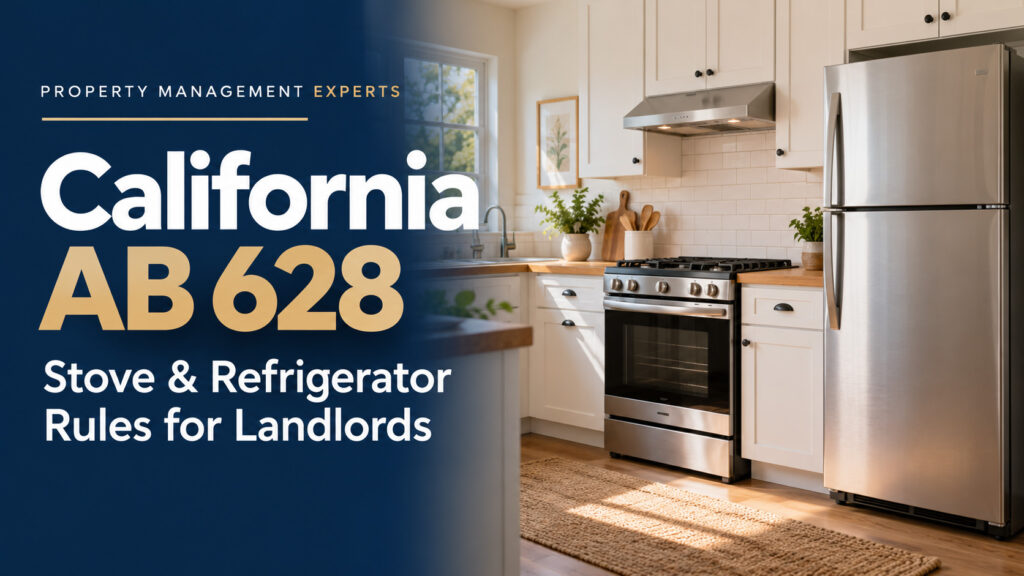
California AB 628 is now in effect. For covered residential leases entered into, amended or extended on or after January 1, 2026, a working stove and refrigerator are part of the state’s habitability standards, subject to specified exceptions. The law also addresses recalled appliances and a tenant’s choice to provide their own refrigerator. [1, 2]
For rental owners in Stockton, Tracy, Modesto and surrounding communities, the practical task is to connect the lease paperwork with what is actually in the kitchen. Confirm who supplies each appliance, whether it works safely and how repair requests and recall notices reach the person responsible for action.
What AB 628 changed
Assembly Bill 628, Chapter 342 of the Statutes of 2025, amended California Civil Code section 1941.1. The section describes conditions a dwelling must meet to be tenantable. AB 628 added a stove maintained in good working order and capable of safely generating heat for cooking, and a refrigerator maintained in good working order and capable of safely storing food. [1]
This is an ongoing condition requirement, not simply a promise to leave an appliance in the unit at move-in. A stove or refrigerator subject to a manufacturer or public-entity recall does not meet the corresponding safe-function standard under the law. [1]
AB 628’s appliance paragraphs apply to leases entered into, amended or extended on or after January 1, 2026. The law therefore should not be summarized as an identical January 1 replacement deadline for every existing tenancy, regardless of its terms or history. Other habitability duties and existing agreements still matter. [1]
Which leases and properties should landlords review
Start with residential agreements signed, amended or extended since January 1, 2026. Check whether the home has the required appliances, whether any statutory exemption applies and whether a tenant-provided refrigerator arrangement satisfies the law. [1]
For an older agreement or an ongoing month-to-month tenancy, have the actual lease and tenancy history reviewed rather than assuming that the absence of a newly signed annual lease settles the question. The statute uses “entered into, amended, or extended”; how that applies to a particular continuation or change can require legal analysis.
The new provisions do not erase existing duties to maintain habitable housing or promises already made in a lease. A landlord should not dismiss a broken-appliance report simply because the original agreement predates 2026. California’s Attorney General explains the broader obligation to provide habitable rental housing. [3]
What the stove and refrigerator requirements mean in practice
Stove
In a covered, nonexempt unit, provide and maintain a stove that works and can safely generate heat for cooking. The law’s tenant-provided appliance option is for refrigerators; it does not create the same opt-out for a stove. [1]
Refrigerator
In a covered, nonexempt unit, provide and maintain a refrigerator that works and can safely store food, unless the tenant has voluntarily chosen a qualifying tenant-provided arrangement. A lease label alone does not resolve responsibility if the required conditions are missing. [1]
The enacted text does not impose a blanket requirement to purchase brand-new appliances or replace every appliance at a particular age. Evaluate operation, safety, recall status and applicable installation requirements. Do not rely on an outdated bill draft or assume that a microwave substitutes for the required stove. [1]
When a tenant can provide their own refrigerator
A tenant and landlord may mutually agree when the lease is signed that the tenant will provide and maintain their own refrigerator. This is a voluntary choice with specific lease requirements, not a way to make every applicant bring an appliance. [1]
The lease must contain a statement substantially in the statutory form acknowledging the landlord’s duty to provide a working refrigerator and, through a checkbox, the tenant’s request to bring their own and responsibility for keeping it working. The lease must also explain the tenant’s right to change that choice. [1]
A tenant may give 30 days’ written notice that they no longer wish to keep their refrigerator in the unit. At the end of that notice period, the landlord must install a refrigerator in good working order. The landlord cannot condition the tenancy on the tenant supplying their own refrigerator and is not responsible for maintaining the refrigerator the tenant provides under this arrangement. [1]
Have the lease language reviewed for the actual tenancy. A generic “refrigerator not included” clause or an informal conversation does not establish that all the statutory conditions have been met.
How the 30-day appliance recall rule works
Civil Code section 1941.1(c) requires the landlord to repair or replace a covered stove or refrigerator subject to recall by the manufacturer or a public entity within 30 days of receiving notice of the recall. Record when notice arrives and verify the appliance’s model and serial number against the recall. [1]
That deadline is not a universal 30-day allowance to leave a dangerous or unusable appliance in service. The law expressly preserves tenant remedies under section 1942. Treat immediate hazards promptly and follow the specific recall instructions, including any instruction to stop using the product. [1]
Use the manufacturer’s information and the US Consumer Product Safety Commission recall database to check affected models and remedies. Keep the notice, vendor communications and proof of the completed repair or replacement in the property file. [4]
Keep recall cases separate from ordinary maintenance requests in your tracking system. A refrigerator that stops cooling needs an assessment based on the actual problem; the recall rule does not set a single response time for every appliance breakdown.
Which units are exempt from the new appliance paragraphs
Section 1941.1(b) lists four categories to which the stove and refrigerator characteristics in paragraphs (10) and (11) do not apply. The definitions matter; an owner should verify the category rather than rely on a marketing label. [1]
- Permanent supportive housing as defined by the referenced Government Code provision.
- A single-room occupancy unit providing living and sleeping space for the occupant’s exclusive use, including units where occupants share food preparation facilities.
- A unit in a residential hotel as defined by the referenced Health and Safety Code provision.
- A dwelling unit within a housing facility offering shared or communal kitchen spaces, including a unit within an assisted living facility.
These exemptions concern the added appliance paragraphs. They are not a blanket exemption from all habitability obligations, and sharing a kitchen does not by itself establish that an ordinary rental fits a defined exempt housing category. [1]
What noncompliance can mean for landlords and tenants
A dwelling that substantially lacks a required characteristic may be deemed untenantable under section 1941.1 for purposes of section 1941. A missing, unsafe or nonworking required appliance can therefore become a habitability issue rather than a disagreement over an optional amenity. [1]
AB 628 does not create one automatic fine or a uniform remedy for every appliance complaint. Existing remedies may apply depending on notice, the condition, the landlord’s response and other legal requirements. Section 1942 provides conditional repair-and-deduct and vacating remedies, and AB 628 preserves access to those remedies in recall cases. [1]
Rent withholding, deductions and ending a tenancy are not automatic consequences that an article can authorize for an individual case. Owners should respond, document the issue and obtain California legal advice on a disputed claim. Tenants should likewise seek advice before taking steps that could lead to a rent or possession dispute.
A practical AB 628 checklist for rental owners
For owners in San Joaquin County and the surrounding Central Valley, make appliance compliance part of the same process used for lease changes, turnover and maintenance. The goal is a property file that explains the arrangement and a response process that works when someone reports a problem.
- Review the agreement and its timeline. Identify leases entered into, amended or extended on or after January 1, 2026, and flag uncertain situations for counsel.
- Confirm coverage. Document any claimed exemption using the applicable statutory category and definition.
- Create an appliance inventory. Record ownership, make, model, serial number, condition and installation information.
- Check operation and recall status. Use qualified vendors where appropriate and keep findings with the property record.
- Update refrigerator paperwork. Use reviewed language for a tenant’s voluntary choice, acknowledgment and right to give 30 days’ written notice.
- Assign responsibility for notices. Track repair requests, recall notice receipt dates and tenant refrigerator notices through completion.
- Budget for delivery and installation. Include removal, lawful access, connections and the cost of a suitable replacement.
- Confirm completion. Keep invoices and communicate the outcome to the resident and owner.
Talk with PME about your rental management needs
Property Management Experts helps owners in Stockton, Tracy and Modesto with tenant placement, rent collection and ongoing property management.
If you want help organizing appliance records, coordinating maintenance or improving communication about your rental, talk with our team about the services your property needs. Have California counsel review lease language and questions about legal coverage.
Frequently asked questions about AB 628
Does AB 628 require every California landlord to buy new appliances?
No. For covered leases, the law requires the specified working and safe appliances, subject to exceptions. It does not require every appliance to be new or impose a blanket age-based replacement schedule. [1]
Can I require a tenant to bring their own refrigerator?
No. The tenant-provided option must be voluntary and meet the statutory lease conditions. The landlord may not condition the tenancy on the tenant supplying a refrigerator. [1]
What if a tenant who brought a refrigerator wants the landlord to provide one?
Under the qualifying arrangement, the tenant may give 30 days’ written notice. At the end of that notice period, the landlord must install a refrigerator in good working order. [1]
Do landlords always have 30 days to fix a refrigerator?
No. The express recall deadline runs from receiving notice of a recall. It is not a blanket response period for every breakdown, and the statute preserves tenant remedies under section 1942. [1]
Does the same tenant opt-out apply to a stove?
No. AB 628 creates the voluntary tenant-provided arrangement for refrigerators, not a parallel stove opt-out. The statutory housing exemptions still need to be considered. [1]
This article provides general information about California AB 628, not legal advice for a particular lease, property or dispute. Other laws, local requirements and the facts of the tenancy may affect your obligations. Consult a California attorney about your circumstances.
Sources and further reading
Reviewed October 27, 2026. The enacted statutory text was checked through the chaptered-text mirror and cross-checked against DRE guidance. The official Legislature pages returned access errors during review.
1. AB 628 enacted text — Chapter 342, Statutes of 2025
Civil Code § 1941.1(a)(10)–(11), (b) and (c). Official Legislature link; a mirror of the chaptered text was used during review because the official page returned an access error.
2. California DRE chaptered bill summaries
Agency summary of AB 628, including the refrigerator option, exemptions and recall rule.
3. California Attorney General landlord tenant guidance
General habitability obligations and landlord-tenant protections.
4. US Consumer Product Safety Commission recalls
Search for appliance recall notices, affected products and remedies.
5. AB 628 chaptered text mirror
Reproduction of the enacted statutory text used to verify the detailed requirements; not a substitute for checking current law.